
The real cost of low cashout: the “almost risk-free” tactic costs 2%
For press and research
Player forums recommend a tactic presented as almost risk-free: set auto-cashout to 1.01x–1.10x to “play through” a bonus wagering requirement while preserving your balance. Chicken Road Productions measured it on the published million rounds of its simulation of the documented model of these games. What the figures let you see: the price does not move. At every cashout target — 1.01x just as at 2.00x — the expected cost is exactly the same: 2% of everything wagered. Cashing out low buys no discount; it only changes how you pay.
- Across 1,000 runs of 1,000 rounds at 1.01x — the order of magnitude of a 1,000-unit wagering requirement — not one, zero out of 1,000, finished ahead: median loss of 20.3 units.
- At 1.01x, each bust wipes out 100 accumulated wins at a stroke: a winning round pays +0.01 units, a bust costs the whole stake.
- Short sessions maintain the illusion: over 100 rounds, the median loss is only 2.03 units — small enough to look like a “preserved” balance, while the 2% meter runs on every unit wagered.
- Public methodology (formula, parameters, seed): these are rounds simulated from the documented model, not rounds measured at an operator. 18+ study, with no promise of winnings.
The complete figures of this study are attached to this page, free to download.
Key takeaways
- This page measures the real cost of low auto-cashout (1.01x–1.10x), the tactic forums recommend for clearing a bonus while “preserving your balance”.
- The reader sees the tactic's exact price: 2% of everything wagered, at every target — and why the feeling of safety comes from short sessions, not from the numbers.
- Zero runs out of 1,000 at 1.01x finished ahead over a complete wagering requirement; the median loss is 20.3 units per 1,000 wagered.
- Every figure comes from the million simulated rounds published by Chicken Road Productions, with the data files free to download on this page.
What exactly does the low-cashout tactic advise?
The low-cashout tactic means setting a crash game's auto-cashout to 1.01x–1.10x and letting the rounds run until a bonus wagering requirement is met. Two independent recommendations, logged by our trend watch on October 13, 2026, describe it in almost the same words: on r/onlinegambling, a BetOnline thread advises finishing a playthrough requirement on a crash game by auto-collecting at 1.01x “to preserve balance”; on r/betrivers, a weekly bonus thread suggests a $0.10 crash game with auto cashout at 1.10x on autoplay, presented as a low-risk bonus-clearing bet.
The promise is precise, and therefore measurable: cash out almost every time, gain and lose almost nothing, while “playing through” the required wagering volume. This page tests the arithmetic of that promise — not its popularity, for which no census exists and none is claimed here.
Does the price change when you cash out lower?
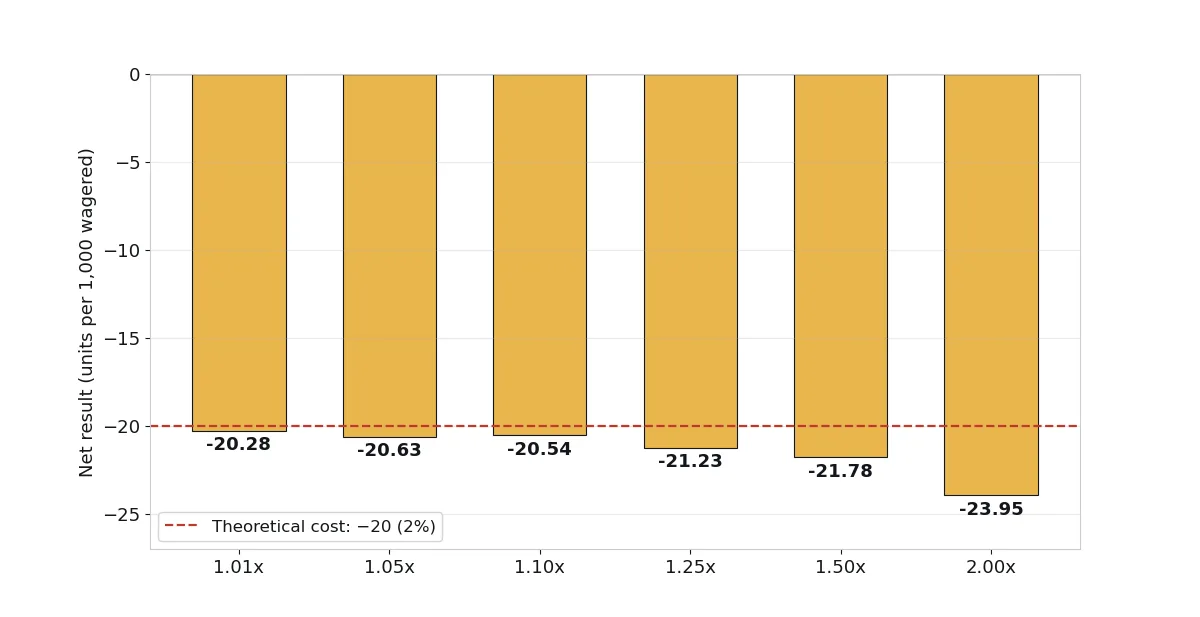
The price does not change: in the documented crash-game model, the expected return of a cashout target c is c × (RTP / c) = RTP. At a 98% RTP, the expected cost is therefore exactly 2% of turnover wagered, at 1.01x just as at 2.00x. The simulated stream confirms the theory, up to sampling noise:
| Cashout target | Rounds won | Net result per 1,000 wagered |
|---|---|---|
| 1.01x | 97.002% | −20.28 units |
| 1.05x | 93.273% | −20.63 units |
| 1.10x | 89.042% | −20.54 units |
| 1.25x | 78.302% | −21.23 units |
| 1.50x | 65.215% | −21.78 units |
| 2.00x | 48.802% | −23.95 units |
Reading: choosing a “safer” target buys a different shape of loss — many small, regular losses instead of more widely spaced ones — never a discount. The 2.00x figure runs above the theoretical 2% because this stream's realized RTP at that target is 97.6%: that is the noise of a sample, even a million-round one, and the theory is given alongside, never instead.
At 1.01x, how many wagering runs finish ahead?
None. Across the 1,000 runs of 1,000 rounds at 1.01x — 1,000 units of turnover wagered, the order of magnitude of a 10x playthrough on a 100-unit bonus — 1,000 out of 1,000 lost money. The median loss is 20.3 units; the best run still loses 5.15 units, the worst 41.51; each run averages 29.98 busts, and at least one bust occurs in 100% of runs, at every target tested.
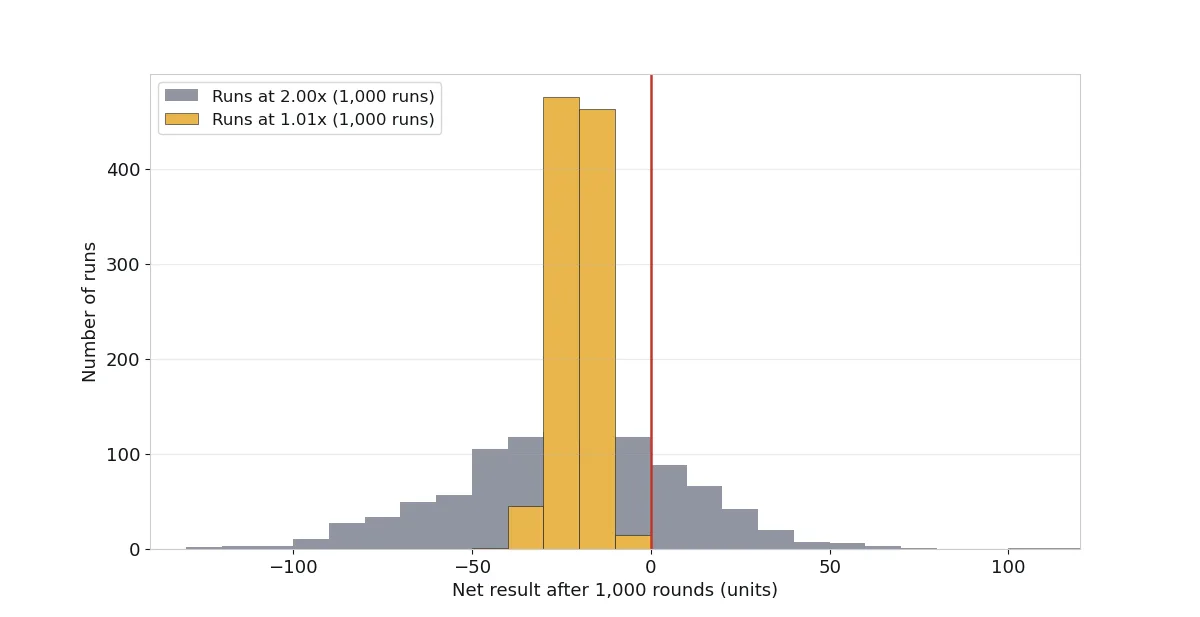
The contrast is instructive: at the same theoretical price, the 2.00x control target keeps a chance — 21.4% of its runs finish ahead, and 76.4% lose. The strategy that feels safest is the only one tested that never — not once in 1,000 complete runs — finished a full wagering requirement ahead.
Why does one bust erase 100 wins?
One bust erases 100 wins at 1.01x because the exchange is asymmetric by construction: each winning round pays +0.01 units, each losing round costs −1 unit. At 1.01x, the player wins 97.002% of rounds — and 2.998% of rounds stop before 1.01x, roughly 3 busts per 100 rounds. A hundred patiently accumulated wins are therefore the stake of a single ordinary bust. The same exchange rate reads at every target: one bust erases 20 wins at 1.05x, 10 at 1.10x, 4 at 1.25x, 2 at 1.50x and 1 at 2.00x. “I win almost every round” and “I lose money” are both true at once — that is the mechanism, not a paradox.
Why do short sessions make it look like it works?
Short sessions hide the meter: over 100 rounds at 1.01x, the median loss drops to just 2.03 units — a small enough amount to pass for an untouched balance. Yet 95.42% of those sessions already lose money. The 4.58% that finish ahead are all sessions with no bust at all, and their maximum gain is +1.00 unit: a “it works” testimonial therefore describes, at best, a session too short to have met the roughly 3 busts that 100 rounds contain on average. The 2% meter, meanwhile, ran on every unit wagered, visible or not.
What do these figures not say?
These figures price the game's margin, and only it: bonus value, cashback, game-weighting percentages toward the wagering requirement and maximum-bet rules are not included. The 1,000-unit run is illustrative turnover — roughly ten times a 100-unit bonus played through — not any named operator's actual terms; the cost is therefore always stated per 1,000 units wagered, never as a figure about one operator's bonus. Finally, the distribution used is the continuous documented crash model — not InOut Games' unpublished per-step multiplier ladder for the stepped game Chicken Road. And there is no human case here: no tracked player, no testimonial — only 1,000 complete runs, downloadable row by row.
“At 1.01x, you win 97 rounds out of 100 — and you still lose on every complete wagering run: low cashout does not lower the price of the game, it only changes the shape of the bill.”
— Andrew Dagor, Chicken Road Productions
Available for an interview or a comment on these data: contact the newsroom via the Press page.
Sources and methodology
References
- Scott, Sher & Daigle, “Cash or Crash: Return to Player Percentages and Expected Value of Crash Games”, UNLV Gaming Research & Review Journal, vol. 30, February 2026 — source of the distribution model and the survival law used here.
- Chicken Road Productions, “Crash game statistics: what 1,000,000 simulated rounds reveal”, 2026 — the published dataset (1,000,000 rounds) from which every figure on this page is drawn: https://chickenroadproductions.com/en/the-real-cost-of-low-cashout/
- Documented recommendations of the tactic (logged October 13, 2026): the r/onlinegambling BetOnline thread (auto-collect at 1.01x to finish a playthrough requirement) and the r/betrivers weekly bonus thread ($0.10 crash game, auto cashout at 1.10x) — cited as the source of the advice tested, not as wrongdoers.
Complete datasets: the per-target summary (6 rows: win rate, realized RTP, net result, sessions and runs) — Download the per-target summary CSV — and the 6,000 runs row by row (1,000 runs × 6 targets: busts, net result, maximum drawdown) — Download the 6,000-runs CSV.
Free reuse for press and research, with attribution: “Source: Chicken Road Productions, The Real Cost of Low Cashout, 2026” — https://chickenroadproductions.com/en/the-real-cost-of-low-cashout/
Our other statistics
The foundation: crash game statistics — what 1,000,000 simulated rounds reveal.
The player portrait: who plays crash games — profile and behavior in figures.
The streak myth: after a run of busts, is the big multiplier 'due'?
The streak myth, in French: le gros multiplicateur est-il « dû » ?
Frequently asked questions
Do these data come from real games played?
No. These are rounds simulated from the documented crash-game distribution model (law P(B ≥ x) = RTP / x, 98% RTP), not rounds measured at an operator. The complete methodology — formula, parameters, seed — is published on this page and the CSV files are downloadable: anyone can verify or reproduce every figure.
Does cashing out at 1.01x really preserve the balance through a wagering requirement?
No. Across 1,000 runs of 1,000 rounds at 1.01x, none finished ahead: median loss of 20.3 units per 1,000 wagered. The balance falls slowly — about 2% of turnover wagered — which can look like preservation over a short session, but the total cost is the same as at any other target.
Why is the cost the same at every target?
Because the expected return of a target c is c × (RTP / c) = RTP: the survival probability falls at exactly the rate the payout rises. Changing the target changes the distribution of losses, never their expectation.
May I quote or reuse these figures?
Yes, freely: credit Chicken Road Productions, the study's title (The Real Cost of Low Cashout, 2026) and a link to this page. Both complete CSVs are downloadable in the section above; for a particular extraction, the newsroom answers via the Press page.