
Why crash-game predictors cannot work: the 10,000-round demonstration
For press and research
Covering crash-game "predictors" — the bots and channels that promise to call the next round? This page tests the promise instead of debating it: a prediction rule of the kind that gets sold plays 10,000 rounds against a fixed cashout that never reads history. The stream of rounds, the seed and the complete data are published — every figure can be checked, replayed and cited.
- The promise, tested in the open: the predictor faces chance round by round — and the race re-runs in one click, with your own settings.
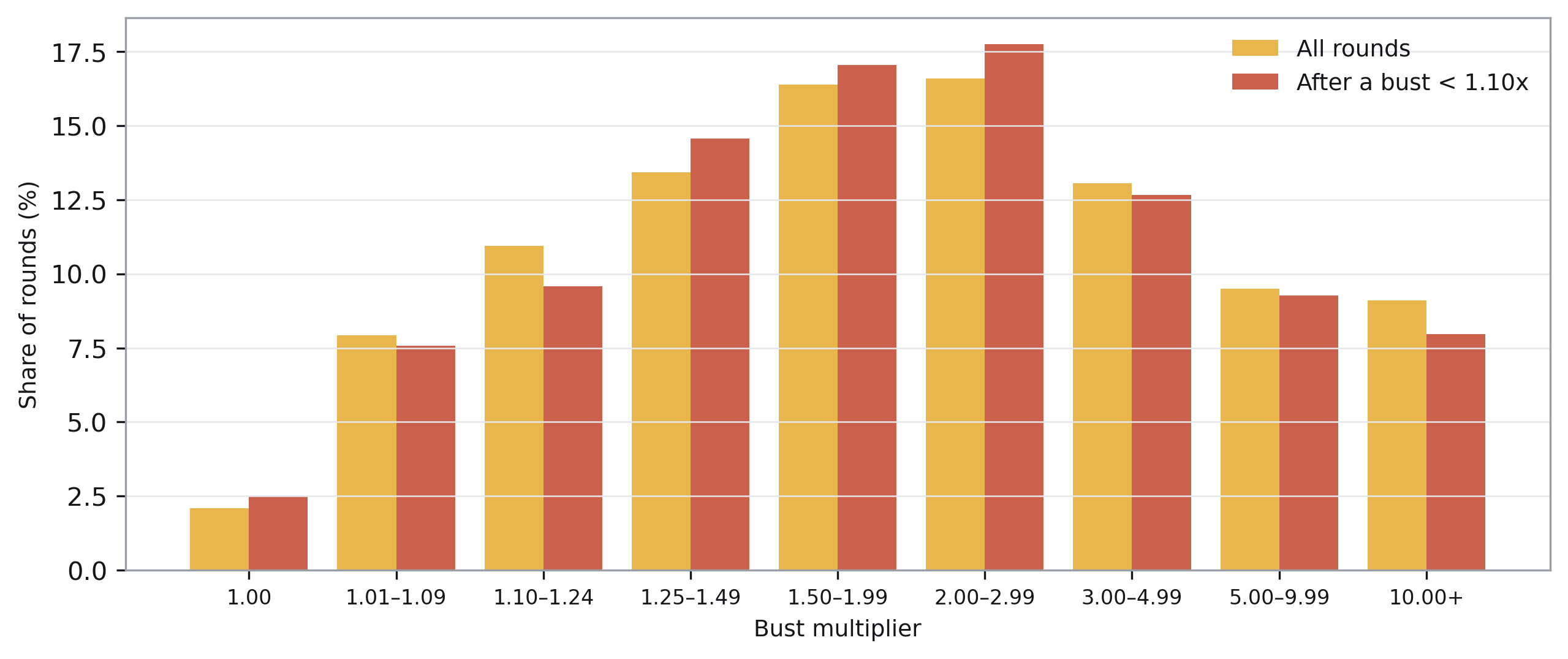
- Independence you can see: the round after a low bust has the same distribution as every other round (median 1.93x vs 1.96x).
- The win-rate trap, quantified: cashing out at 1.01x wins 9,790 of 10,000 rounds — and still loses 112 units.
- A complete, open file: all 10,000 rounds as CSV, the tested rule written out in full, a reproducible method.
The complete dataset is attached to this page, free to download.
The short version: the predictor loses, and chance has nothing to hide
Over the same 10,000 rounds, the prediction rule loses 218.5 units where the fixed cashout — which never reads history — loses 160 (1% edge scenario). At a 3% edge, the same story: −387.5 against −352. Reading the past contributed nothing: the slope of both curves is set by the edge, and on this stream the "signal" finishes behind the control. As for the round that follows a low bust, it looks neither like revenge nor like a trap: it looks like every other round.
What would a predictor actually have to predict?
The stopping multiplier of the next round — and in provably fair crash games, that value is already fixed when betting opens. The mechanism, in one paragraph: before the round, the operator's server generates the outcome and publishes a cryptographic fingerprint of it (a hash); after the round, the key is revealed and anyone can check that the outcome matches the fingerprint announced in advance. The operator has therefore committed to the result before seeing your bets — and from your side, when you bet, that result already exists but cannot be read: extracting it would mean breaking the cryptographic commitment or reading the server itself.
The direct consequence: "predicting" the next round is not a matter of game analysis. Software that reads history, schedules or "trends" is working on data that does not contain the answer — the answer is sealed before the round and depends on none of it. Our guide to crash-game mechanics (in French) walks through the mechanism step by step, and our reading of the UNLV "Cash or Crash" study sets out the published mathematics behind it.
Why do past rounds say nothing about the next one?
Because every round is an independent draw from the same distribution. Past multipliers are not an input to the next draw: the generator receives no memory, no counter of "recent busts", no debt owed to players. The distribution itself is stable and known — across 1,000,000 simulated rounds, half of all rounds stop before 1.95x and about 1 in 10 reaches 10.00x. Knowing that describes the game; it says nothing about the round that is coming.
That is exactly the terrain of the gambler's fallacy: after two low busts, intuition insists the next round "has to" climb — or, in the opposite sales pitch, that "the low streak will continue". The two readings contradict each other, which is the tell that both are reading noise: a pattern that can narrate everything and its opposite is not a pattern. A signal that cannot exist cannot be sold — what remains is to check, with numbers, what a rule of this kind actually produces when it is left to play.
Try it yourself: the predictor vs chance
Pick the number of rounds, the edge scenario and the predictor's target, then watch the two curves: they sink together, at the pace set by the edge — the "signal" displayed round by round changes nothing about the slope. Then switch to the signal test: the distribution of the round after a low bust overlaps the distribution of all rounds. Both arms play the same stream of rounds as the reference simulation below (seed 20261014); only the signal target and the length are adjustable.
With predictor
No signal: the predictor cashes out at 1.50x
No predictor
Fixed cashout at 1.50x — history is never read.
What the simulation shows: 10,000 rounds, one seed
The reference simulation plays both rules over the same stream of 10,000 rounds (a one-unit stake per round), under two edge scenarios labelled as scenarios — 1% and 3%, which are not any specific game's published RTP. The "predictor" rule is the sellers' rule, written out in full: after two busts below 1.50x, it "smells" the rebound and holds for 2.00x; otherwise it cashes out at 1.50x.
| Scenario | Rule | Rounds won | Net result | Max drawdown |
|---|---|---|---|---|
| 1% edge | With predictor | 63.31% | −218.5 units | 261.5 units |
| 1% edge | No predictor (fixed 1.50x) | 65.60% | −160.0 units | 194.5 units |
| 3% edge | With predictor | 62.04% | −387.5 units | 427.0 units |
| 3% edge | No predictor (fixed 1.50x) | 64.32% | −352.0 units | 380.5 units |
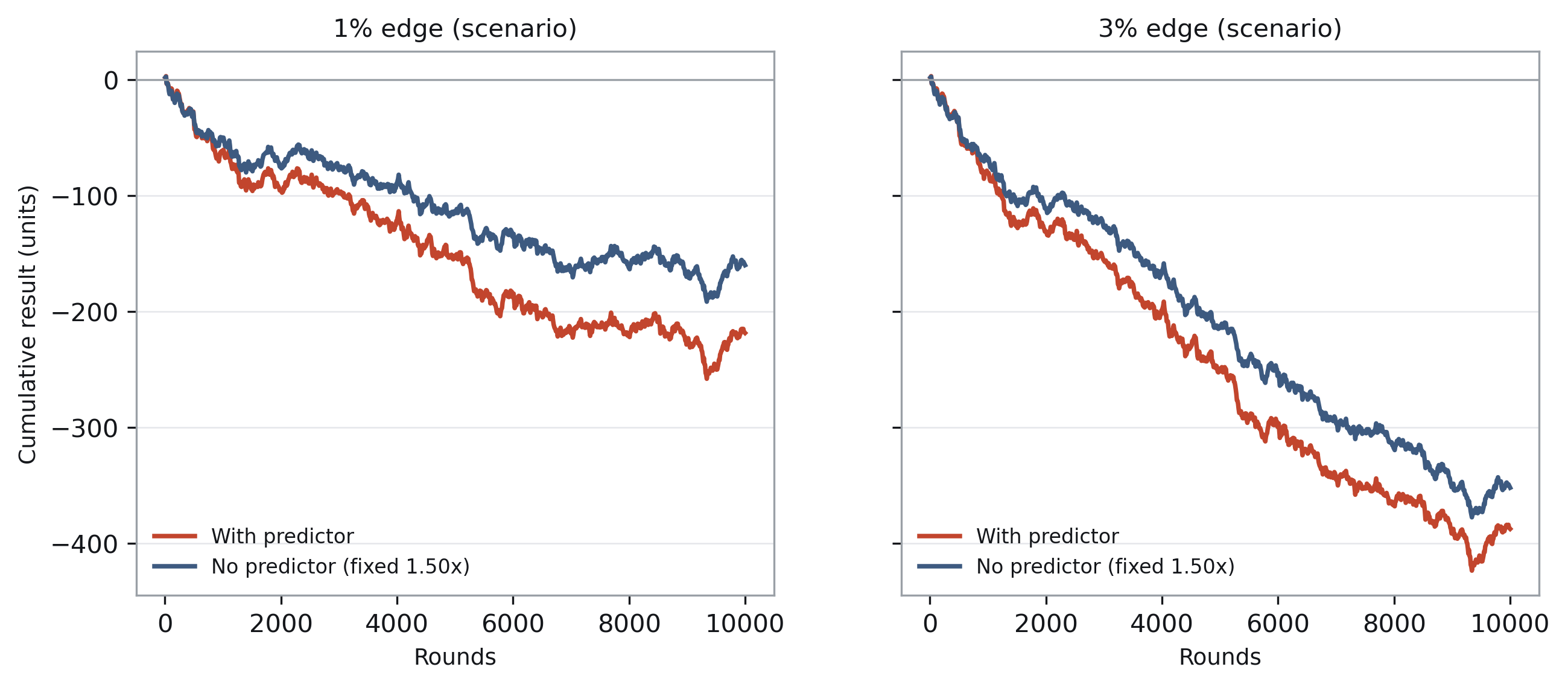
How to read this: the gap between the two rules is the noise of this particular stream — on another draw it could reverse, and that is precisely the point: nothing in reading history moves the expectation. What does not move, from one scenario to the next, is the slope: it belongs to the edge. The signal test confirms it from another angle. Among the 1,003 rounds that follow a bust below 1.10x (1% edge), the median bust is 1.93x, against 1.96x across all rounds; 34.2% of them stop below 1.50x, against 34.4% in general. In other words, "after a low bust" is not a state of the game: it is a label pasted onto ordinary chance.
One last figure — the one in the screenshots. Cashing out systematically at 1.01x on this same stream "wins" 9,790 of 10,000 rounds — a 97.9% win rate — for a net result of −112.1 units. Winning often and losing anyway: that is the arithmetic of every round carrying a 1% edge, and it is that win rate, without the balance, that predictor marketing puts forward.
So why do the sellers look successful?
Because you never see their losing rounds. The edit is always the same: screenshots of wins — genuine or fabricated — selected after the fact, never the complete session log. It is survivorship bias applied to marketing: across thousands of buyers and millions of rounds, winning streaks worth photographing always exist, including when playing at pure chance. The streak exists; it proves nothing about the next round, as the signal test above shows.
The business model does the rest. The "free predictor" often serves as a funnel: sign up with a partner operator, deposit, then a "premium" subscription when the free signals "expire". The product being sold is not a forecast — which does not exist — but your deposit and your subscription. The warning signs on the player side — prediction promises, urgency, "exceptional" pricing — are detailed in our Chicken Road 2 scam dossier (in French), including the fake proof that circulates around these offers.
"A predictor does not read the future: it reads noise. Over 10,000 rounds replayed identically, the prediction rule loses more than the fixed cashout that ignores history — because there is nothing to know that the edge has not already decided."
— The Chicken Road Productions editorial team
Available for an interview or a comment on this data: contact the editors via the Press page.
Sources and methodology
References
- Scott, Sher & Daigle, "Cash or Crash", UNLV Gaming Research & Review Journal, February 2026 — our reading: The science of crash games (2026 study).
- Chicken Road Productions, Crash game statistics: what 1,000,000 simulated rounds reveal, 2026 — the full distribution this demonstration's orders of magnitude come from.
- Chicken Road Productions, Mécaniques des jeux crash (in French) — how provably fair and multiplier curves work, step by step.
Full dataset: 10,000 rows (one per round: the busts under both edge scenarios and the cumulative result of both rules), in CSV format — the exact file every figure and chart on this page is drawn from, and the stream the interactive demonstration replays. Download the CSV
Free to reuse in press and research, with attribution: "Source: Chicken Road Productions, 'Why crash-game predictors cannot work' — 10,000-round simulation, standard crash-game model, 2026" — https://chickenroadproductions.com/en/guides/crash-game-predictors/
Frequently asked questions
Can a free predictor work?
No — free or paid, it is the same claim, and it fails for the same reasons: the next round is an independent draw whose outcome is sealed before betting opens. "Free" changes the business model, not the mathematics: it most often serves as a funnel towards a deposit with a partner operator, or towards a subscription.
What about an AI trained on millions of rounds?
It learns the distribution — the shape of busts, their frequencies — never the next round: past rounds contain no information about the next draw, so there is nothing more to learn. Our statistics over 1,000,000 rounds show exactly what a very large history contains: a distribution, not an oracle.
Are Telegram signals any different?
No. A "signal" is a predictor with a distribution channel: the same claim ("the next round will climb"), the same absence of foundation. Whether the tip arrives by bot, by channel or by app changes neither the independence of the draws nor the cryptographic commitment that seals the outcome before the round.