
Crash gambling: anatomy of an online gambling category
For press and research
Crash games fill online casino lobbies, yet the category itself has no settled definition and no encyclopaedia article — in English or in French. This study defines it in three conditions, describes how its crash point is determined according to the developers' own published documents, and measures its distribution over 1,000,000 rounds: citable figures, an open methodology, and the full dataset as a free download.
- A definition in three conditions: a rising multiplier, a randomly drawn crash point, and a single decision — cash out before the stop.
- Three documented families for determining the crash point: hash chains, server and player seeds, certified generators.
- A measured result that settles the strategy debate: at a fixed cash-out, the expected loss stays at about 2% of everything wagered, whatever target is chosen.
- 1,000,000 rounds recomputed for this study: 3.00% of rounds stop at 1.00x, the median bust is 1.95x, 0.97% of rounds reach 100.00x.
The complete data is attached to this page as a free download.
The essentials: the category in 5 figures
Where these figures come from: they are drawn from the documented distribution model of crash games — the law P(bust ≥ x) = RTP / x derived by Scott, Sher & Daigle (UNLV Gaming Research & Review Journal, 2026)[1] — applied to 1,000,000 simulated rounds at the 98% RTP that InOut Games publishes for Chicken Road.[2] For this study, every figure was recomputed from the raw 1,000,000-round file, in a pass independent of the one that produced them. These are not rounds measured at an operator: they are the computed consequences of the model the developers publish, checkable by anyone who downloads the data.
What a crash game is: a definition in three conditions
A crash game is an online gambling game that meets three conditions, all of them necessary:
- A rising multiplier. Each round starts a multiplier at 1.00x and grows it, continuously or in steps, with no practical ceiling known to the player in advance.
- A randomly drawn crash point. The round ends at a multiplier — the crash point — determined by a random draw, fixed before the round begins or at the moment it launches, and unknown to the player while it runs.
- A single decision: cash out before the stop. The player bets before the start, then chooses the moment to withdraw the stake multiplied by the displayed value. If the crash point is reached first, the stake is lost.
Remove one condition and you leave the category: a slot machine has neither a rising multiplier nor a decision window; roulette has a draw, but no decision during the draw; a classic table game decides before chance, never during it. Our reading: it is the decision during the draw that makes the category — and that explains most of what follows, from the draw mechanisms to player psychology.
The first documented instance dates to 2014: the cryptocurrency casino Bustabit launched the format under the name MoneyPot (Scott, Sher & Daigle, 2026).[1] Cryptocurrency casinos produced their own versions, then mainstream operators followed — Rocket at DraftKings, cited by the same study.[1] Today the form comes as a continuous curve (a plane, a jet, a rocket) or as a step-by-step grid, but the three conditions do not change.
How the crash point is determined: three documented families
The crash point is not decided during the round: it is fixed by the draw before the round begins, then revealed by its course. Developers document three families of mechanisms.
The hash chain — Bustabit
Bustabit, the original game, generates in advance a chain of SHA-256 hashes in which each link is the fingerprint of the next; round outcomes are read by walking the chain backwards, so no result can be altered after the fact without breaking the chain. To stop the operator from choosing a chain that suits it, the chain is salted with the hash of a future Bitcoin block, unknown at commitment time — the current chain rests on block 917,000 (mechanism described by Scott et al., 2026, from Bustabit's documentation and Medina, 2025).[1] After each round, anyone can verify that the result belongs to the announced chain.
Server and player seeds — Aviator (Spribe)
Spribe documents a "provably fair" system for Aviator: the server commits its seed by publishing its hash before the round, and the result combines that seed with the client seeds of the first three players to bet. The server seed is revealed after the round; the player can then recompose the computation and verify that the crash point was fixed before take-off — by the operator and by the first players themselves, whose seeds form part of the draw.[3]
Certified generators and studio seed systems
Versions distributed by licensed operators rest on a random number generator certified by testing laboratories, without round-by-round publication of the draw (the case for mainstream versions such as Rocket). Studios that distribute their games to hundreds of operators — InOut Games for Chicken Road, SmartSoft for JetX — document in-game verifiable seed systems of their own: the result's hash can be inspected and the draw checked after the round inside the interface.[4] The forms differ; the shared property is constant across the category: the crash point is determined before the player's decision begins. No documented mechanism makes the draw depend on the bets in progress or on cash-outs already made.
The operator's margin is written into the draw itself. In the reference continuous model it takes two forms: a return factor (0.98 for a 98% RTP) that erodes every probability, and a mass of rounds stopped immediately at 1.00x — measured here at 3.00% of rounds. A player who understands the category starts there: roughly one round in 33 leaves no decision to take.
Cash-out: the player's single decision
During the round, the player controls neither the draw, nor the multiplier's speed, nor the ceiling. The player controls one parameter: the moment of exit. That decision can be taken by hand, mid-round, or fixed in advance with auto cash-out, which withdraws the stake as soon as the chosen target is reached. Multiple bet panels in parallel — two in Aviator, up to three in JetX — multiply the decisions, not their nature: each bet is a separate wager on the same crash point.
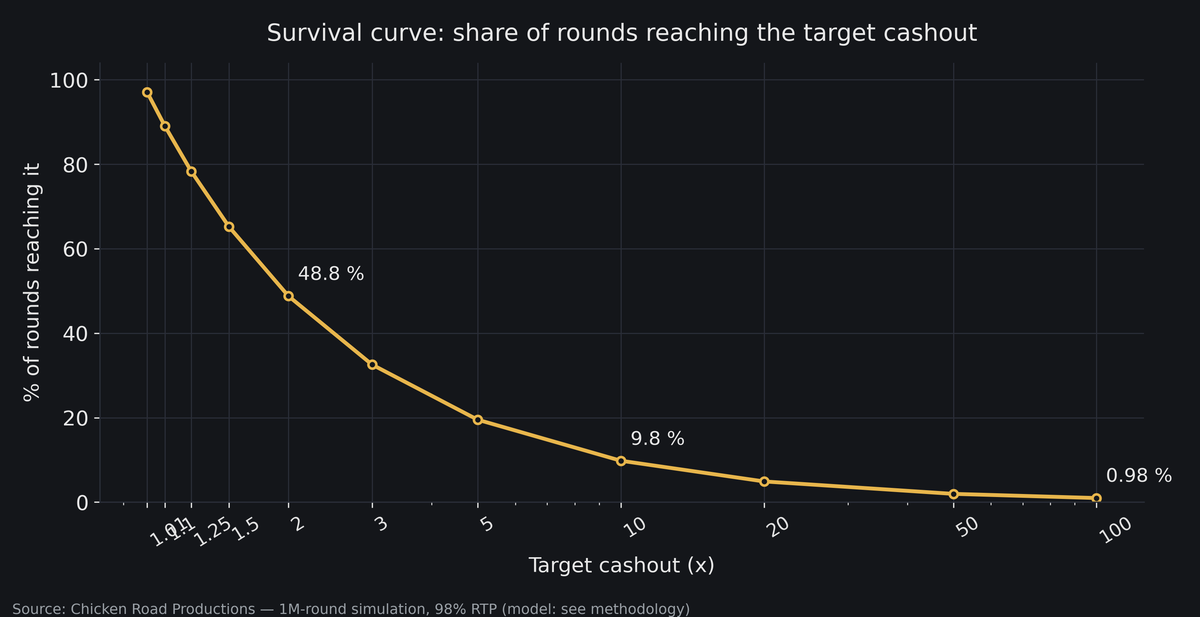
Mathematically, the decision moves the variance, not the expectation. Here is what a fixed auto cash-out returns at eight targets, measured on the 1,000,000 rounds (constant one-unit stake):[5]
| Cash-out target | Winning rounds | Realised RTP | Expected loss per 100 units wagered |
|---|---|---|---|
| 1.01x | 97.00% | 97.97% | 2.03 |
| 1.10x | 89.04% | 97.95% | 2.05 |
| 1.25x | 78.30% | 97.88% | 2.12 |
| 1.50x | 65.22% | 97.82% | 2.18 |
| 2.00x | 48.80% | 97.61% | 2.39 |
| 3.00x | 32.55% | 97.64% | 2.36 |
| 5.00x | 19.52% | 97.58% | 2.42 |
| 10.00x | 9.80% | 97.96% | 1.96 |
Our reading: exiting early wins often and little; exiting late wins rarely and much; in both cases the game returns about 98 units per 100 wagered and keeps about 2. The deviations around 98% are the sampling noise of a million rounds, not a ranking of targets — our study of the real cost of low cash-out reaches the same result through complete wagering runs.[6] Our reading: any pitch that presents one target as "better" than another confuses the frequency of wins with their expectation.
What 1,000,000 rounds measures
The typical round is short: half of all rounds stop before 1.95x, and the most populated zone runs from 1.50x to 3.00x — a third of all rounds. Large multipliers exist, but they are rare by construction: 9.80% of rounds reach 10.00x, 0.97% reach 100.00x.[5]
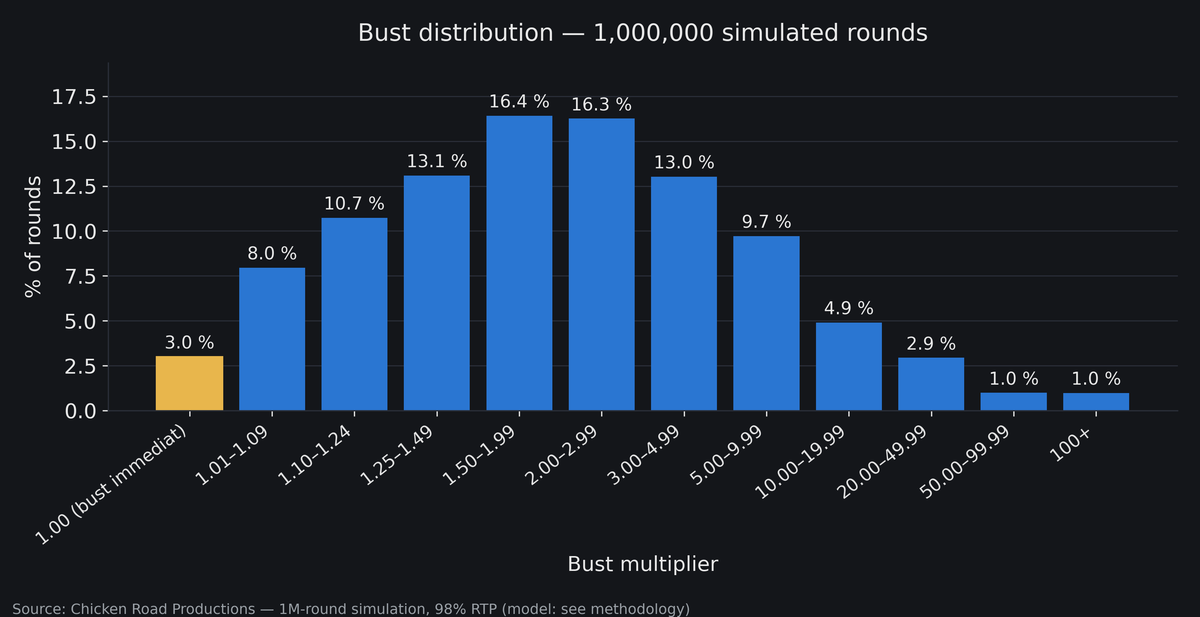
| Crash point (multiplier) | Rounds | Share |
|---|---|---|
| 1.00 (instant stop) | 29,982 | 3.00% |
| 1.01 – 1.09 | 79,602 | 7.96% |
| 1.10 – 1.24 | 107,401 | 10.74% |
| 1.25 – 1.49 | 130,869 | 13.09% |
| 1.50 – 1.99 | 164,123 | 16.41% |
| 2.00 – 2.99 | 162,564 | 16.26% |
| 3.00 – 4.99 | 130,306 | 13.03% |
| 5.00 – 9.99 | 97,109 | 9.71% |
| 10.00 – 19.99 | 48,995 | 4.90% |
| 20.00 – 49.99 | 29,410 | 2.94% |
| 50.00 – 99.99 | 9,893 | 0.99% |
| 100.00 and above | 9,746 | 0.97% |
The agreement with the published law is this study's quality control: at the thirteen measured thresholds, the share of rounds reaching the threshold tracks the 0.98 / x prediction within 0.2 percentage points — 48.80% against 49.00% at 2.00x, 9.80% against 9.80% at 10.00x, 0.97% against 0.98% at 100.00x.[1] Our reading: the mean crash point summarises nothing — it is dragged by a handful of extreme rounds (the observed maximum exceeds 3,000,000x) — and the median, 1.95x, is the fair summary of the typical round.
Five products, one shape
The category reads through its instances. The five products below — the original, the two world leaders, and the two titles this site covers daily — all meet the definition's three conditions; what varies is the multiplier's presentation, the number of bet panels, and the documented way the crash point is drawn.
| Product | Developer | Form | Published RTP | Crash-point determination (documented) |
|---|---|---|---|---|
| Bustabit (born MoneyPot) | Bustabit, 2014 | Continuous curve | Advertised house edge: 1% | SHA-256 hash chain generated in advance, salted with a future Bitcoin block; results verifiable by walking the chain |
| Aviator | Spribe, 2019 | Continuous curve (plane), 2 bet panels | 97% | Provably fair: server seed committed by its hash before the round, combined with the first three players' seeds |
| JetX | SmartSoft, 2018 | Continuous curve (jet), up to 3 bet panels | 97% in the most common configuration (operator-configurable) | Provably fair: crash point generated and hashed before the round, verifiable afterwards |
| Chicken Road | InOut Games, 2024 | Step-by-step grid, 4 difficulty levels | 98% | Verifiable seed system documented by the developer; the difficulty level sets volatility, not RTP |
| Chicken Road 2 | InOut Games, 2025 | Step-by-step grid | 98% | Same mechanical family as Chicken Road: verifiable seeds, a decision at every step |
Two of our readings stand out. Our reading: Chicken Road's step form does not change the nature of the decision — advancing one step or letting a curve run are the same repeated wager, staying exposed one moment longer against a higher multiplier. Our reading: published RTPs spread from 97% to 99% across products, and with identical mechanics, that parameter — and it alone — sets what the category costs the player over time, about 1 to 3 units per 100 wagered.
Why the category fools intuition
The academic literature on crash games names two springs. The first is the illusion of control (Langer, 1975; 1977, taken up by Scott et al., 2026)[1]: the player holds the exit button, and so feels like an actor in a result that is in fact drawn entirely before the decision — the control bears on exposure, never on the crash point. The second is apophenia, the tendency to read patterns into independent sequences: a run of early stops would make a large multiplier "due", or the reverse. Our measurement of crash-game predictors priced it over 10,000 rounds: the rule that reads history loses more than the fixed cash-out that ignores it.[7] Rounds are independent; the curve has no memory — and that is precisely what the distribution above demonstrates: every round replays the same probabilities, whether the previous one stopped at 1.00x or at 500.00x.
Our analysis: what our recomputation adds to the documented format
Everything above describes the format as the literature and the developers document it. What follows is our analysis, and it mixes three things that we distinguish at every step: the findings of Scott, Sher & Daigle and of the developers' published documentation, credited to them and cited; our calculations on the published 1,000,000-round corpus, flagged as ours, with their margins; and our interpretations, labelled as such.
The three-condition definition is our own construction. Scott, Sher & Daigle's study describes the format; closing it into three necessary conditions — each one excludes a neighbouring family: slot machines, roulette, table games — is this study's work, and all five products in the table above meet all three. The check on that construction is the recomputation: from the corpus's raw file we reproduced the bucket distribution to the unit, and at the thirteen survival thresholds the measured share never strays more than 0.2 percentage points from the theoretical law — at 2.00x, 48.80% measured for 49.00% predicted.[5]
Cash-out invariance is a computation, not an opinion. On the same corpus, at a constant one-unit stake, realised RTP at the eight fixed targets runs from 97.58% to 97.97%, with no ordering: the lowest target tested (1.01x) and one of the highest (10.00x) return almost the same rate — an unordered spread, of exactly the size that sampling noise produces at this scale. Our study of complete wagering runs finds the same invariance from the other end — two independent computation paths, one result.[6]
Our reading: the shape changes, the decision does not. Step grid or continuous curve, the wager is the same — staying exposed one moment longer against a higher multiplier — and each developer's published return parameter, from 97% to 99%, alone sets what the category costs over time. Likewise, the honest summary of a round is not its mean, dragged by a few extreme rounds, but its median: 1.95x. That is why this study publishes the whole distribution rather than an average rate.
Sources and methodology
If you are a journalist or a researcher and want an extract, a particular format, or a comment on this data, contact the newsroom via the Press page. We are an independent publication; this study is self-funded and its data is free to reuse with attribution. Spribe, SmartSoft, InOut Games and Bustabit did not review or approve this analysis before publication.
Frequently asked questions
What is a crash game, in one sentence?
An online gambling game in which a multiplier rises from 1.00x to a randomly drawn crash point, and in which the player decides only one thing: cash out the multiplied stake before the stop, or lose it.
Is the crash point decided before the round?
Yes, in every mechanism the developers document: a hash chain generated in advance (Bustabit), a server seed committed before the round and combined with player seeds (Aviator), or the certified generator of licensed versions. The round's course reveals the crash point; it does not choose it.
Can the crash point be predicted?
No. Rounds are independent and the draw is fixed before the decision; our measurement over 10,000 rounds shows a prediction rule based on history losing more than a fixed cash-out that ignores history (−218.5 units against −160 units on the same corpus).[7]
Does the cash-out target change what the game returns?
It changes the frequency and the size of wins, not the expectation: measured over 1,000,000 rounds, realised RTP stays between 97.6% and 98.0% from 1.01x to 10.00x — the expected loss is about 2% of everything wagered at every target.
Why do about 3% of rounds stop at 1.00x?
It is one of the forms the operator's margin takes in the distribution model: a mass of rounds ends immediately, with no decision window. In our 98% RTP corpus it measures 3.00% (29,982 rounds out of 1,000,000).
Do these figures come from real games played?
No: they are the measured consequences of the published distribution model of crash games, simulated over 1,000,000 rounds with the announced parameters (formula, 98% RTP, seed 20261013). The methodology is published above and the data is downloadable — anyone can reproduce every figure.
References
- Scott, R. H., Sher, M. M. & Daigle, J. (2026). "Cash or Crash: Return to Player Percentages and Expected Value of Crash Games", UNLV Gaming Research & Review Journal, 30(1). DOI: 10.9741/2327-8455.1509 — history of the format (MoneyPot, 2014), derivation of the law P(bust ≥ x) = RTP / x, provably fair mechanisms and player psychology. ↑
- InOut Games — official Chicken Road and Chicken Road 2 game information: published 98% RTP, verifiable seed system, consulted 29 October 2026. ↑
- Spribe — official Aviator game information: provably fair system (server seed and player seeds) and 97% RTP, Spribe product pages, consulted 29 October 2026. ↑
- SmartSoft — official JetX game information: provably fair system and published RTP, consulted 29 October 2026. ↑
- Dagor, A. (2026). "Crash game statistics — 1,000,000 simulated rounds", Chicken Road Productions. Dataset deposited on Zenodo, DOI: 10.5281/zenodo.23597144 — the corpus whose figures this study recomputes. ↑
- Dagor, A. (2026). "The real cost of low cash-out", Chicken Road Productions. DOI: 10.5281/zenodo.23613581 — expected-loss invariance verified through complete wagering runs. ↑
- Dagor, A. (2026). "Prédicteurs de jeux crash : la démonstration en 10 000 manches" [Crash-game predictors: the 10,000-round demonstration], Chicken Road Productions — repetition of a prediction rule over 10,000 rounds (seed 20261014): −218.5 units for the rule against −160.0 for the fixed 1.50x cash-out, on the same corpus. /guides/predicteurs-jeux-crash/ ↑